


Quick Answer: Knowledge management improves productivity, reduces redundant work, accelerates onboarding, prevents knowledge loss during turnover, and enables faster customer service. Enterprise teams with strong knowledge management systems save employees nearly one full day per week that would otherwise be spent searching for information.
What Is Knowledge Management — and Why Does It Matter?
Knowledge management is the process of capturing, organizing, storing, and sharing information across an organization so employees can find what they need, when they need it.
For enterprise teams, this means making institutional knowledge — processes, documentation, tribal knowledge, and operational context — available through a centralized, searchable system rather than scattered across dozens of disconnected tools.
Why it matters now: McKinsey research on workplace collaboration found that the average knowledge worker spends nearly 20% of their workweek searching for information. That’s one full day per week, per employee, lost to inefficient knowledge access. At enterprise scale, that cost compounds into millions of dollars in lost productivity annually.
Without effective knowledge management, employees routinely:
- Spend 2 minutes searching for a document they forgot the URL of
- Spend 10 minutes tracking down a colleague who holds critical information
- Spend 30 minutes recreating work that already exists somewhere
Who benefits most from knowledge management?
- Enterprise teams managing large, distributed workforces
- Organizations with high employee turnover
- Remote and hybrid teams operating across time zones
- Customer-facing teams that need fast, accurate answers
The 10 Most Important Benefits of Knowledge Management
Benefit Framework Overview
Here’s a quick-reference breakdown of how the benefits of knowledge management map to organizational outcomes:
| Category | Benefits |
| Operational efficiency | Reduce redundant work, break down silos, streamline onboarding |
| Employee productivity | Faster information access, fewer interruptions, less context-switching |
| People & retention | Better employee experience, higher engagement, preserve knowledge during turnover |
| Customer outcomes | Faster resolution, more consistent answers, higher satisfaction |
| AI & search readiness | Better AI tool performance, faster knowledge retrieval, scalable search |
1. Increase Team Productivity
One measurable benefit of knowledge management is productivity improvement. When employees can access information instantly, they make faster decisions, solve problems more efficiently, and maintain workflow momentum without interruptions.
The 2024 Microsoft and LinkedIn Work Trend Index on the state of AI at work found that 79% of business leaders believe their organization must adopt AI and stronger knowledge systems to remain competitive.
A well-structured knowledge management system enables employees to:
- Find answers in seconds instead of minutes
- Reduce unnecessary meetings and Slack interruptions
- Complete tasks without workflow friction or dependency on colleagues
This shift — from searching to executing — compounds into significant performance gains across every department.
2. Eliminate Redundant Work
Redundant effort is one of the largest hidden costs inside organizations. Without centralized knowledge systems, employees frequently recreate documents, processes, reports, training materials, and workflows — simply because they don’t know existing resources exist.
Effective knowledge management makes institutional knowledge visible, searchable, and reusable. Teams stop duplicating effort, accelerate execution, and maximize operational efficiency.
3. Break Down Cross-Departmental Silos
Knowledge silos form when departments store information in disconnected systems:
- Marketing assets live in Google Drive
- Product documentation lives in Confluence
- Sales data lives in Salesforce
- Support knowledge lives in Zendesk
Without unified knowledge access, cross-team collaboration breaks down and alignment suffers. Enterprise knowledge management platforms connect these systems into a single searchable experience — so employees can find information regardless of where it lives. The right knowledge sharing tools make this cross-system discovery seamless for every team.
Result: Stronger cross-team collaboration, better strategic alignment, and greater organizational transparency.
4. Improve Remote and Hybrid Work Processes
According to Neat’s 2025 State of Remote Work statistics, over 32.6 million Americans work remotely — representing 22% of the U.S. workforce. In distributed environments, waiting for colleagues across time zones introduces friction and slows execution.
Knowledge management removes the dependency on synchronous communication. Employees self-serve access to policies, process documentation, technical resources, and project context — improving autonomy, velocity, and job satisfaction without waiting for a response.
5. Streamline Onboarding and Training
Few benefits of knowledge management deliver faster ROI than accelerated onboarding. A Panopto study on the value of workplace knowledge found employees may spend as long as 3.5 months searching for information and unknowingly recreating work that already exists.
A modern knowledge management system enables:
- Centralized onboarding hubs with structured learning paths
- Easy discovery of training materials and role-specific resources
- Intuitive navigation that reduces time-to-productivity for new hires
Tools like GoLinks let teams create memorable internal short links — go/onboarding, go/benefits, go/policies — so new employees spend less time searching and more time contributing.
6. Prevent Knowledge Loss During Employee Turnover
Employee turnover is one of the most serious threats to organizational continuity — yet most organizations underestimate it until it’s too late. A Gartner report found that 46% of employees already struggle to find the information they need in a fully staffed organization. When key people leave, that gap widens fast.
Deloitte’s 2025 research on strategies for workforce evolution found that 60% of employees believe AI-powered tools are essential for capturing tacit knowledge before retirement or departure — a signal that the workforce itself recognizes the risk.
Effective knowledge management converts people-held expertise into documented, searchable institutional memory — so when someone leaves, the knowledge doesn’t leave with them.
7. Ignite Innovation and Growth
Innovation requires access to existing ideas, context, and institutional history. Knowledge management fosters this by enabling:
- Transparent idea sharing across teams
- Asynchronous brainstorming without meeting overhead
- Easy access to historical decisions, past projects, and past experiments
Instead of relying solely on meetings, teams continuously contribute insights, learnings, and improvements — building a culture of experimentation and continuous innovation.
8. Improve the Employee Experience
The Coveo 2025 Employee Experience Relevance Report found that 40% of employees feel frustrated when they can’t access the right tools or information to do their jobs effectively — a key driver of stress, disengagement, and attrition.
Effective knowledge management reduces this friction by:
- Lowering cognitive load and decision fatigue
- Building employee confidence through reliable information access
- Improving day-to-day work satisfaction
Employees who feel supported and informed are more likely to stay, perform, and engage.
9. Boost Employee Engagement
Access to knowledge directly influences engagement. When employees can find answers quickly, collaborate effectively, and contribute meaningfully, they develop stronger ownership and autonomy. This drives:
- Higher engagement and intrinsic motivation
- Stronger organizational commitment and belonging
- A shift from passive task execution to active problem-solving
Knowledge management doesn’t just remove friction — it turns task-takers into problem-solvers.
10. Deliver Better Customer Service
One of the most overlooked benefits of knowledge management is its direct impact on customer experience. When customer-facing teams can instantly access accurate, up-to-date information, they:
- Resolve issues faster
- Provide more consistent answers across channels
- Reduce escalations and repeat contacts
- Improve first-contact resolution rates
Higher consistency leads to higher customer satisfaction, stronger loyalty, and better brand perception.
Why Knowledge Management Is Important for Enterprise Teams
The importance of knowledge management scales with organizational complexity. The larger the team, the more information fragments across tools, people, and processes — and the harder it becomes to surface the right answer at the right moment.
Key reasons why knowledge management is important:
- AI tools perform better with structured knowledge — Large language models and internal AI assistants are only as useful as the knowledge they can access. Well-managed, well-structured knowledge bases dramatically improve AI search quality.
- Hybrid work demands async information access — Synchronous communication doesn’t scale across time zones. Knowledge management enables asynchronous self-service.
- Turnover risk is rising — With 60% of employees flagging knowledge transfer as a critical concern, organizations that manage institutional knowledge proactively avoid expensive capability gaps.
- Complexity compounds without systems — Every new tool added to a tech stack creates another information silo. Without proactive knowledge management, the friction compounds year over year.
Knowledge Management System Benefits: What a Good Platform Delivers
A knowledge management system is the technology layer that makes knowledge management work at scale. The right platform should deliver:
- Unified search across all tools and data sources (Google Drive, Confluence, Salesforce, Zendesk, etc.)
- Intuitive access so employees can find what they need without knowing exactly where it’s stored
- Governance and freshness controls to keep knowledge accurate and up to date
- AI-ready structure so internal AI tools and LLMs can surface relevant knowledge reliably
- Frictionless sharing so institutional knowledge spreads organically, not just during onboarding
How to Start Implementing Better Knowledge Management
For many organizations, knowledge management becomes a priority only after inefficiencies become painful. Forward-thinking companies treat knowledge as strategic infrastructure from the start. Understanding the full knowledge management process — from knowledge capture through distribution and governance — is the foundation for getting implementation right.
To build a successful knowledge management strategy:
- Audit your knowledge landscape — identify where information lives, how it’s accessed, and where the biggest gaps are
- Centralize access — connect disparate tools into a single searchable experience
- Make discovery intuitive — ensure employees can find information without knowing where it’s stored
- Enable real-time search across tools — reduce dependency on knowing which tool holds which information
- Simplify sharing — make it easy to capture and redistribute institutional knowledge before it walks out the door
GoLinks: The Fastest Way to Modernize Knowledge Access
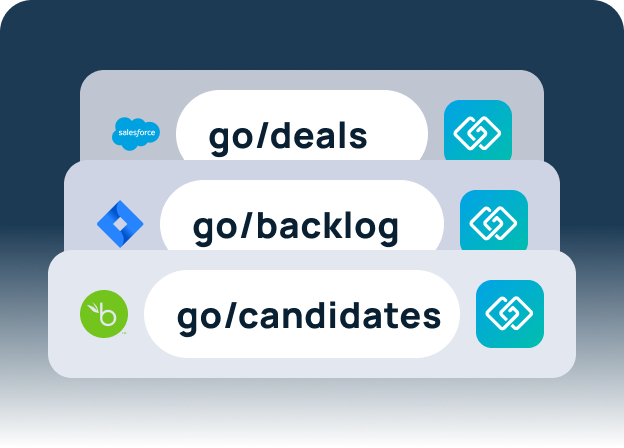
GoLinks allows teams to create intuitive short links for internal resources — making knowledge easy to access, share, and remember. Instead of hunting for long URLs or buried bookmarks, employees simply type:
- go/sales-playbook
- go/roadmap
- go/support-docs
- go/onboarding
Stop losing a day a week to searching. Try GoLinks for free and give your team instant access to everything they need.
Access and share resources instantly with GoLinks
Try for free