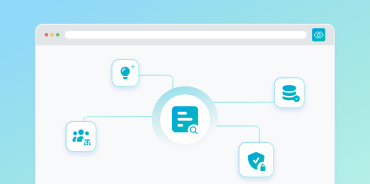


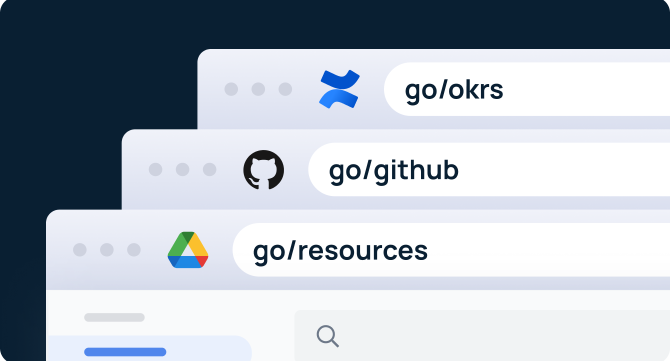

Internal short links are memorable URLs, like go/benefits, that take employees instantly to a resource in any workplace tool. They act as the access layer of a company’s knowledge management system, giving each resource one stable name across Confluence, Google Drive, Slack and Jira.
Internal short links, also called go links or go/links, give teams a direct path to the resources they use at work. Instead of digging through nested folders, switching between tools, or asking a coworker where something lives, an employee types go/sprint or go/benefits and lands on the page.
In Coveo’s survey of US and UK employees, workers reported spending an average of 3.6 hours a day searching for information, and 60% said they search four or more data sources every day. When knowledge is spread across Confluence, Google Drive, Slack, Jira and a dozen other tools, finding the right version of a document becomes a task of its own.
Internal short links solve the access side of that problem. They work as a navigation layer across a company’s knowledge management systems: one name for every resource, wherever it lives.
What Are Internal Short Links?
Internal short links are human-readable shortcuts that send employees to internal tools, documents and resources. Unlike public URL shorteners such as Bitly, they’re built for workplace knowledge, not public sharing. Internal short links:
- Work only for people signed in to your company account
- Use short, memorable names, like go/roadmap
- Keep working when a resource moves
- Respect the permissions of the tool they open
You might use Bitly to share a link on social media. Internal short links, like those created with GoLinks, apply the same idea inside your organization, with company sign-in, link ownership and admin controls.
Internal short links have been around for more than a decade: engineers at NCSU and Google built early versions to reach internal resources in a few keystrokes. GoLinks brings the same approach to teams of any size, without custom engineering.
How Internal Short Links Work
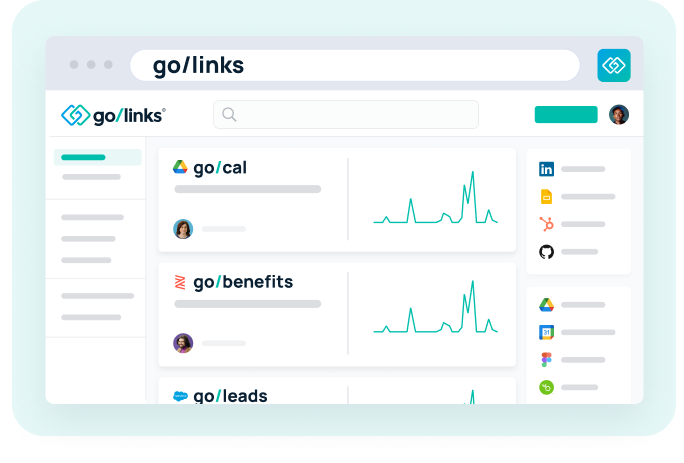
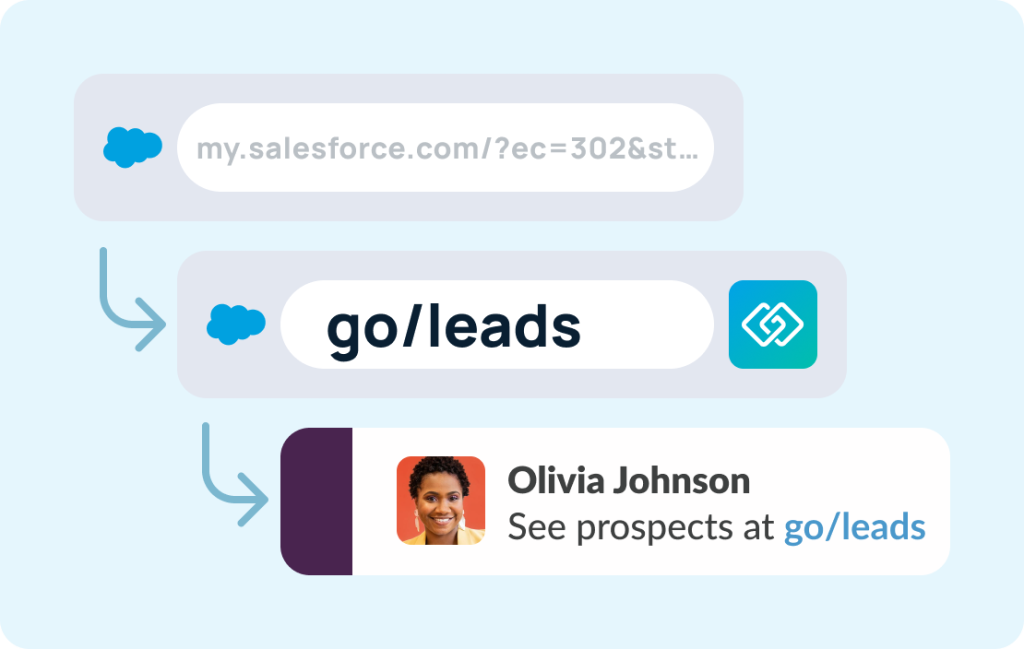
Internal short links resolve in four steps:
- An employee types go/benefits into a browser, Slack or a doc.
- GoLinks confirms the employee’s identity through SSO or email sign-in.
- GoLinks resolves the shortcut to its current destination URL.
- The destination tool applies its own permissions, so a private Jira board or Google Doc stays private.
Internal short links never override existing tool permissions; they shorten the path to the resource.
How Internal Short Links Support Knowledge Management
A knowledge management process has seven steps, from finding what matters to retiring what’s outdated. Internal short links support each step, and they matter most at sharing and reuse: making organized knowledge easy to reach.
| Knowledge management step | What go links do | Example |
|---|---|---|
| Identify critical knowledge | Usage data and weekly insights emails show which resources people open most | go/benefits trending during open enrollment |
| Capture | The browser extension turns any page into a go link in one click | Saving a new runbook as go/incident-runbook |
| Organize and structure | Naming conventions, tags and variable links | go/eng-roadmap, go/ticket/234 |
| Store and maintain | Destination updates keep links working when content moves | go/handbook after a Confluence-to-Notion move |
| Share and distribute | Links work in Slack, meetings, and docs | go/q3-plan in a meeting agenda |
| Apply and reuse | Click trends show which resources teams return to | go/demo opened by every new sales hire |
| Review, improve, and retire | Usage data flags dormant links for update or archive | Retiring go/2025-kickoff |
They give every resource one stable address. When HR moves the handbook from Confluence to Notion, an admin updates the destination in GoLinks. Every go/handbook link in Slack threads, docs and onboarding emails keeps working.
They connect resources across repositories. One naming system spans Google Drive, Confluence, Jira and Slack through GoLinks integrations, so employees learn one convention instead of five folder structures. It’s the same principle behind a consistent taxonomy when you build a company knowledge base.
They cut navigation steps for known resources. Typing go/expenses replaces opening the wiki, finding the finance space and clicking through to the policy.
They show which knowledge people use. Link usage analytics flag stale, duplicate and unused resources, so owners know what to update and what to retire.
They keep knowledge reachable when people leave. When a link owner leaves the company, an admin reassigns their links. Every go link they shared in docs, Slack and onboarding materials keeps working, so the resources outlast the person who organized them.
They give AI assistants the same names employees use. With the GoLinks MCP connector, employees can use go links in Claude to find and create team shortcuts without leaving the conversation.
Internal Short Links vs. Enterprise Search, Intranets and Bookmarks
Internal short links work best when employees know what they need, like the benefits portal or the brand kit. Enterprise search works better for open questions, such as “what did we decide about Q3 pricing?” Most teams use both: go links for the resources people open every week, and go links with enterprise search for everything else. Inside GoLinks, AI-powered resource search with GoAI helps employees find a resource when they don’t know its link name.
| Option | Best for | Authentication | Usage analytics | Governance | Setup effort |
|---|---|---|---|---|---|
| Internal short links (GoLinks) | Frequently used resources | SSO or email sign-in | Per-link clicks and trends | Owners, admin controls, naming rules | Low: browser extension + SSO |
| Wiki or knowledge base (Confluence, Notion) | Storing and organizing documentation | SSO | Page views | Space owners, page permissions | Medium: structure and migration |
| Enterprise search | Finding answers across apps | SSO, permission-aware results | Query analytics | Connector and permission settings | Medium: connectors per app |
| Intranet | Company news, policies, landing pages | SSO | Page views | Page owners, publishing workflow | Medium to high |
| Browser bookmarks | Personal shortcuts | None | None | None; not shared | None |
| Public URL shorteners (Bitly, TinyURL) | Sharing links outside the company | None for visitors | Click analytics | Account-level only | Low |
| Custom-built redirect service (compare with GoLinks) | Engineering teams that can maintain their own tool | Depends on the build | Only if the team builds it | Only if the team builds it | High, plus ongoing maintenance |
These options work together more often than they compete. A wiki or knowledge base stores the documentation, enterprise search finds answers across it, and go links give employees a direct path to the pages they use most.
What Internal Short Links Change for Teams
Internal short links deliver four measurable outcomes. Each one below includes a metric to track after rollout.
1. Knowledge sharing without the back-and-forth. Employees type go/<keyword>, or say a link out loud in a meeting, instead of asking in Slack or tagging a coworker. Measure: repeat “where is this?” requests in help and team channels before and after rollout.
2. Faster ramp for new hires. A few core go links replace memorizing tools and file paths, so new employees reach key resources from day one. See how go links fit an employee onboarding program. Measure: onboarding survey scores and time to first independent task.
3. The current version, every time. A go link points to the live doc or dashboard, not a copy saved months ago. When the sprint board changes, go/sprint changes with it. Measure: clicks on the canonical link versus traffic to duplicate copies.
4. Visibility into tool and resource use. Daily, weekly and monthly usage data shows which resources teams rely on and which go unused. IT and operations teams use it to remove duplicates, cut unused tools and track adoption. Measure: link clicks by team and by resource.
Internal Short Link Examples by Department
Every team has a few resources that employees ask for over and over. Start with links like these:
| Team | Shortcut | Destination | What it replaces |
|---|---|---|---|
| Company-wide | go/holidays | Holiday calendar in the HR system | Asking coworkers for the holiday schedule |
| IT | go/help | IT service desk portal | Searching the wiki for the ticket form |
| HR | go/benefits | Benefits enrollment portal | Digging through onboarding emails |
| Engineering | go/sprint | Current sprint board in Jira | Bookmarking a board that changes each sprint |
| Sales | go/demo | Current demo deck | Searching Drive for the current deck |
| Customer success | go/escalations | Escalation playbook | Pinging a manager for the process |
| Marketing | go/brand | Brand guidelines | Re-sending the same file link |
| Finance | go/expenses | Expense policy and submission form | Two separate lookups |
Variable go links handle dynamic content: go/ticket/234 opens ticket 234 directly, with no search or navigation.
How to Roll Out Internal Short Links
Adoption grows when employees see go links in their daily work, not when the library gets bigger. Use this checklist for a company-wide rollout:
- Connect SSO so employees sign in once with their company account.
- Set naming rules early: short, lowercase names, with team prefixes only when needed. See go link naming conventions.
- Create links for the 20 most-requested resources, such as benefits, holidays, the expense policy and the current sprint.
- Name a link owner for each department to keep its links accurate and up to date.
- Decide how to handle duplicates: one canonical link, with aliases for common alternate names.
- Add go links to onboarding so new hires learn go/benefits and go/help in week one.
- Use links where work happens: meeting agendas, Slack channel topics and doc templates.
- Review link usage analytics monthly for unused and broken links.
Governance: What to Avoid as Your Library Grows
As a go link library grows, it can fill up with duplicates, dead links and unclear names. Most of these problems come from a missing rule, not a missing feature. For more, see governing short links at scale.
| Common issue | Best practice |
|---|---|
| Two teams want the same name | Use a team prefix (go/eng-roadmap vs. go/mkt-roadmap) or a shared page that points to both |
| Several names for one resource | Keep one canonical link and add aliases for common alternates |
| Long or overly specific names | Keep names to one to three words a new teammate could guess |
| Reserved names | go/d is reserved for the GoLinks directory |
| Destination moves to a new tool | Update the destination; the short link stays the same everywhere it was shared |
| Link owner leaves the company | Admins reassign ownership |
| Stale or never-used links | Set expiration or review prompts and check usage analytics |
| Personal links cluttering the shared directory | Use private links for individual shortcuts [Editor: confirm with product] |
| One link, different resources by office or region | Use geo-links that route employees by location |
Getting Started with Internal Short Links
Internal short links work alongside your wiki, shared drives and search tools, making the knowledge stored there easier to reach. Start with the resources your team asks for most, set a few naming rules, and let usage data show what to add next.
Get started with GoLinks for free and give every resource on your team one name that’s easy to find and share.
Access and share resources instantly with GoLinks
Try for free
Frequently Asked Questions About Internal Short Links
Yes. Internal short links handle the access part of knowledge management. They give each resource one stable, memorable name across tools like Confluence, Google Drive, and Slack, and their usage data shows which knowledge people rely on and which has gone stale.
External shorteners like Bit.ly create public links for sharing outside a company. Internal short links require sign-in through SSO, keep each tool’s existing permissions and use names employees can guess, like go/brand. They’re built for secure navigation inside a company, not public link distribution.
Use internal short links for resources employees already know they need and open often, like go/benefits or go/sprint. Use enterprise search for open questions, where the employee doesn’t know which document holds the answer. Most companies use both.
Yes. A go link can point to any URL, so one naming system covers pages in Confluence, files in Google Drive, boards in Jira and channels in Slack. GoLinks integrations let employees use and share go links without leaving those apps. If a resource moves, the owner updates the destination and the link keeps working.
Set naming rules early: short, lowercase names like go/jira or go/expenses. Keep one canonical link per resource, with aliases for common alternates, and keep personal links out of the shared directory. Name an owner for each department’s links, review usage analytics monthly for unused links, and have admins reassign links when owners leave.
Yes. Short, guessable names are easy to say and remember. GoLinks treats hyphens, underscores and no separator as equivalent, so go/all-hands, go/all_hands and go/allhands open the same link.