


Enterprise knowledge management (EKM) is the strategy and technology organizations use to capture, organize, secure, and deliver company knowledge across every system and team, so employees and AI tools get accurate, permission-aware answers. It combines enterprise search, knowledge repositories, expertise directories, and workflow tools under one governance model.
As more work runs through AI assistants and agents, the quality of that knowledge sets the quality of the answers. Organizations that capture, structure, and activate knowledge at scale make decisions faster and deploy AI with more confidence.
This guide covers:
- What enterprise knowledge management is
- Why enterprise knowledge management matters in 2026
- How modern enterprise knowledge management platforms work
- How a corporate knowledge base and short links fit into enterprise knowledge management
- Enterprise knowledge management tools compared
- How enterprise knowledge management supports AI systems
- How to evaluate enterprise knowledge management solutions
What Is Enterprise Knowledge Management?
In modern enterprises, knowledge is not just stored — it is continuously surfaced, contextualized, and activated at the moment of need.
Enterprise knowledge management (EKM) is the strategy, technology architecture, and operational framework organizations use to capture, organize, secure, govern, and activate institutional knowledge across systems, teams, and workflows — enabling both employees and AI systems to access accurate, permission-aware information in real time.
At its core, enterprise knowledge management ensures that knowledge is:
- Discoverable — Easily searchable across systems and repositories
- Trustworthy — Accurate, current, and version-controlled
- Secure — Permission-aware and compliant with governance policies
- Actionable — Embedded directly into workflows and decision processes
- AI-ready — Structured and accessible for retrieval, reasoning, and automation
Unlike isolated tools such as standalone wikis, intranets, or file repositories, enterprise knowledge management is an enterprise-wide strategy. It connects systems of record, search and retrieval infrastructure, workflow platforms, and AI technologies into a unified knowledge layer that supports both human productivity and intelligent automation.
In AI-first organizations, this unified knowledge layer becomes foundational infrastructure — powering faster decisions, more reliable automation, and more confident AI adoption.
Why Enterprise Knowledge Management Matters
Enterprise knowledge management has evolved from a “nice to have” capability into strategic infrastructure — directly shaping AI performance, workforce productivity, and long-term organizational resilience.
1. AI Systems Depend on Enterprise Knowledge
AI is only as effective as the enterprise knowledge it can access.
Modern enterprise AI requires:
- High-quality organizational context
- Real-time or near-real-time data access
- Permission-aware knowledge delivery
- Structured, searchable content
- Secure, governed retrieval mechanisms
Without strong enterprise knowledge management foundations:
- AI answers become outdated
- Hallucinations increase
- Trust declines
- Adoption slows
When employees begin questioning accuracy — Is this current? Is this secure? Is this complete? — confidence drops. And without confidence, AI usage stalls.
Enterprise knowledge management is now foundational to responsible, trustworthy AI deployment.
2. SaaS Fragmentation Is Growing
Most enterprises operate across dozens — often hundreds — of systems.
Enterprise knowledge becomes fragmented across:
- Messaging platforms
- Project management tools
- Documents and file systems
- CRM and ticketing platforms
- Internal wikis and intranets
- HR systems and employee profiles
Without a cohesive enterprise knowledge management strategy:
- Employees waste 20% or more of their time searching for information instead of executing work
- Teams unknowingly duplicate efforts, recreating assets that already exist
- Constant context switching fragments attention and reduces deep work capacity
- Decisions are made without full visibility into existing knowledge or prior insights
- AI systems operate without reliable, governed enterprise context — increasing errors and lowering trust
The result is measurable drag on productivity, slower decision cycles, and reduced confidence in both human and AI-driven workflows.
Enterprise knowledge management acts as a unifying layer — connecting fragmented systems into a cohesive, searchable, governed knowledge ecosystem.
3. Institutional Knowledge Is at Risk
Remote work, organizational restructuring, and workforce turnover have fundamentally increased the risk of institutional knowledge loss. When expertise lives in inboxes, chat threads, or individual memory, it disappears the moment someone leaves or changes roles.
Enterprise knowledge management reduces this risk by preserving, structuring, and governing institutional knowledge before it disappears — transforming individual knowledge into durable organizational intelligence.
Why EKM Matters in 2026
- AI performance depends on structured, governed, and permission-aware enterprise knowledge
- SaaS fragmentation makes information harder to find, validate, and confidently use
- Institutional expertise is increasingly at risk due to turnover, remote work, and organizational change
- Enterprise knowledge management has become core infrastructure — not optional tooling
In 2026, organizations that treat knowledge as infrastructure move faster, make better decisions, and deploy AI with greater confidence. Those that don’t face growing inefficiency, reduced trust, and slower innovation.
Enterprise Knowledge Management vs. Enterprise Search vs. Intranet vs. Wiki
| Category | Primary Purpose | Limitation When Used Alone |
|---|---|---|
| Enterprise Knowledge Management (EKM) | End-to-end strategy for capturing, structuring, governing, and activating institutional knowledge across the organization | Requires integrated systems, defined governance models, and executive alignment to deliver full value |
| Enterprise Search | Enables cross-system discovery of information from multiple repositories | Does not ensure content quality, lifecycle management, or structured governance |
| Intranet | Serves as a central hub for company communications, announcements, and key resources | Often static, manually updated, and disconnected from real-time operational systems |
| Wiki | Provides structured documentation for processes, playbooks, and knowledge sharing | Limited discovery capabilities, inconsistent governance, and minimal real-time workflow activation |
Enterprise knowledge management is the umbrella strategy.
Enterprise search, intranets, and wikis are important components — but on their own, they do not create a governed, AI-ready, enterprise-wide knowledge layer.
In 2026, leading organizations treat these tools as parts of a broader knowledge architecture — not as standalone solutions.
The Enterprise Knowledge Management Framework
Enterprise knowledge management is not a product you install — it is infrastructure you build. High-performing organizations architect EKM as an integrated system that unifies data sources, retrieval intelligence, workflow execution, and security into a durable competitive advantage.
1. Capture
Continuously collect knowledge where work happens
Enterprise knowledge originates across:
- Documents and file systems
- Messaging and collaboration tools
- Project and ticketing platforms
- CRM and HR systems
- Meetings and subject matter experts
Modern EKM platforms automate capture through:
- Real-time integrations
- AI summarization and extraction
- Workflow ingestion
- Meeting transcription
- Event-driven updates
For example, GoSearch connects to enterprise systems through indexed and real-time connectors, refreshing shared content every few minutes and querying sensitive data live to minimize knowledge lag.
Why it matters:
Automated capture prevents knowledge decay, reduces documentation burden, and keeps enterprise context fresh for both employees and AI systems.
2. Structure
Transform raw information into organized, AI-ready knowledge
Captured knowledge must be structured to become usable.
This includes:
- Metadata schemas
- Tagging frameworks
- Ontologies and taxonomies
- Knowledge graphs
- Relationship mapping across systems
Structured enterprise knowledge improves:
- Human discovery
- AI retrieval precision
- RAG accuracy
- Governance enforcement
GoSearch enhances this layer by preserving system-level metadata and permission models — ensuring structured, context-aware retrieval without duplicating sensitive data.
Without structure, search degrades and AI responses lose reliability.
3. Retrieve
Enable fast, permission-aware access across systems
The retrieval layer is where enterprise knowledge becomes accessible.
Modern platforms combine:
- Semantic search
- Vector search
- Federated, real-time retrieval
- Natural language querying
- Contextual ranking
GoSearch exemplifies this layer through hybrid retrieval — combining federated real-time access with intelligent ranking to deliver accurate, permission-aware answers.
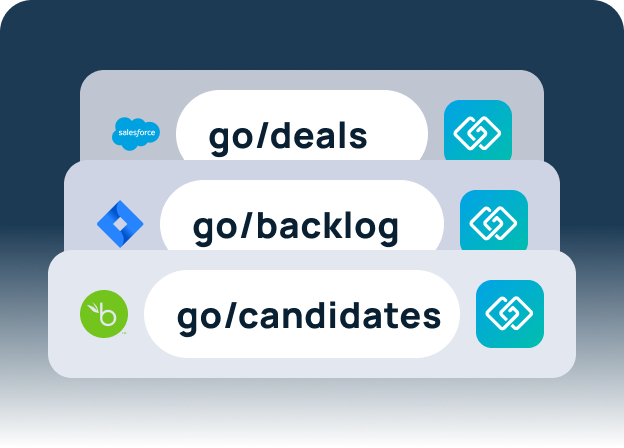
At the same time, GoLinks supports retrieval by creating structured, memorable short links (e.g., go/benefits, go/security-policy, go/q4-plan) that standardize access to institutional knowledge across teams. Go links can point to any internal file, doc, dashboard, or app URL, so employees reach the source in one step.
Together, retrieval systems and structured link management reduce search friction and increase knowledge consistency.
4. Activate
Embed knowledge directly into workflows and decisions
Knowledge only creates value when it drives execution.
Activation includes:
- Surfacing knowledge inside workflows
- Sharing short links to internal files and dashboards in the tools teams already use
- Delivering answers at the point of work
- Enabling AI agents to reason over enterprise context
- Triggering automated actions
- Reducing friction between discovery and execution
GoSearch Workflows enable teams to move from answers to action — connecting retrieval to execution across enterprise systems.
GoLinks strengthens activation by embedding standardized links directly into Slack, email, onboarding docs, and operational playbooks — ensuring knowledge is not just stored, but repeatedly used.
This is the shift from knowledge storage to operational intelligence.
5. Govern
Enforce security, compliance, and trust at every layer
Enterprise knowledge management must embed governance into the architecture itself.
This includes:
- Permission inheritance from source systems
- Data lineage and traceability
- Auditability
- Compliance enforcement
- Retention and lifecycle controls
GoSearch’s real-time, permission-aware model ensures AI responses respect source-system security policies — rather than bypassing them through duplicated indexes.
Governance is not a feature. It is the foundation of AI trust.
Capture → Structure → Retrieve → Activate → Govern
- Capture knowledge automatically across systems
- Structure it for discoverability and AI precision
- Retrieve it securely and in real time
- Activate it inside workflows
- Govern it to maintain trust and compliance
Together, they support a modern enterprise knowledge architecture built for AI-first organizations.
Types of Enterprise Knowledge Management Tools
Enterprise knowledge management is not delivered by a single tool category. It typically combines multiple interconnected systems — each addressing a different layer of the knowledge lifecycle.
1. Knowledge Repositories and Wikis
Primary Strength: Structured documentation and institutional memory
These systems centralize policies, playbooks, and process documentation in an organized format.
Limitation:
They often remain static repositories. Without strong retrieval, governance, and workflow integration, knowledge may exist — but not be consistently discovered or activated.
2. Enterprise Search Platforms
Primary Strength: Cross-system discovery
Enterprise search enables employees to find information across documents, collaboration tools, ticketing systems, and cloud platforms from a single interface.
Limitation:
Search quality depends on content structure, metadata consistency, and governance. Search alone does not improve knowledge accuracy or lifecycle management.
3. Employee Knowledge and Expertise Platforms
Primary Strength: Surfaces tacit and human knowledge
These platforms map employee expertise, skills, and organizational relationships — helping teams locate subject matter experts and informal knowledge sources.
Limitation:
They require ongoing profile maintenance and cultural adoption to remain accurate and useful.
4. Workflow and Automation Systems
Primary Strength: Connect knowledge to execution
Workflow platforms integrate knowledge directly into operational processes, enabling automation, AI agents, and cross-system task execution.
Limitation:
Deep integrations and governance alignment are required to ensure workflows operate on trusted, permission-aware knowledge.
5. Knowledge Analytics Tools
Primary Strength: Visibility into knowledge usage and gaps
Analytics platforms reveal search behavior, content performance, expertise networks, and knowledge bottlenecks — informing continuous improvement.
Limitation:
Insights are often underutilized without executive ownership and structured governance processes.
The Strategic Shift
True enterprise knowledge management integrates these categories into a cohesive architecture.
When these tools operate independently, knowledge remains fragmented.
When integrated under a unified EKM strategy, they form a secure, AI-ready knowledge layer that supports discovery, activation, and governance at scale.
Competitive advantage does not come from having these tools — it comes from connecting them.
How Short Links Turn a Corporate Knowledge Base Into Enterprise Knowledge Management
A corporate knowledge base stores company documentation; enterprise knowledge management makes that knowledge findable wherever employees work. Short links close the gap: with GoLinks, anyone can turn the URL of a doc, dashboard, or internal file into a memorable link like go/onboarding or go/architecture and share it across Slack, Microsoft Teams, and the browser.
Many knowledge bases make content easy to write and hard to reach. Links run long, break when pages move, and only work inside one tool. A link layer gives each resource one stable name, no matter which app hosts it.
What a Corporate Knowledge Base With Built-In Link Sharing Should Do
- Link to any internal file. A go link can point to any URL, including docs, dashboards, wikis, repos, and tickets. Variable go links like go/ticket/104 jump straight to a specific record.
- Share links where people work. Go links work in Chrome, Firefox, Safari, Opera, and Brave, and inside Slack, Microsoft Teams, Zoom, and Notion through GoLinks integrations.
- Organize by team or project. Collections group related links, while tags and aliases help teammates find the same resource under different names.
- Open several resources at once. Multi-links launch a set of URLs from one go link, such as everything a new hire needs on day one.
- Find resources with AI. GoAI suggests resources and answers questions about internal knowledge.
- Spot gaps and stale resources. Insights and analytics show which links get used, and weekly workspace updates surface new and trending links.
- Control access. Private and unlisted go links limit who can use them, and SSO, SCIM provisioning, and role-based permissions manage users. The source app still decides who can open the file behind the link.
Corporate Knowledge Base Solutions With Link Shorteners Built In, Compared
Among these four tools, only GoLinks creates custom short links to content in any app. Confluence generates short links for its own pages, while Notion and SharePoint depend on third-party tools for short or custom links.
| Tool | Built-in short links | Custom link names | What links can point to | Best for |
|---|---|---|---|---|
| GoLinks | Yes | Yes (go/onboarding) | Any URL in any app | A shared access layer across every tool |
| Confluence | Yes, auto-generated tiny links | No | Confluence pages only | Teams that document in Confluence |
| Notion | No | Only through third-party tools | Notion pages | Teams that document in Notion |
| SharePoint | No | Only through add-ins | SharePoint and OneDrive content | Microsoft 365 organizations |
For a wider comparison of platforms on connectors, security, and governance, see Best Knowledge Management Tools for Enterprise.
How Enterprise Knowledge Management Supports AI
In AI-first organizations, the quality, structure, and governance of enterprise knowledge directly determine AI performance, trust, and scalability.
1. Retrieval-Augmented Generation (RAG)
Retrieval-Augmented Generation (RAG) systems enhance large language models (LLMs) by grounding responses in enterprise knowledge.
RAG systems:
- Retrieve relevant enterprise data in real time
- Inject verified context into LLM prompts
- Improve factual accuracy
- Reduce hallucination risk
- Provide citations and traceability
Strong enterprise knowledge management strengthens RAG by ensuring:
- Knowledge is structured and searchable
- Permissions are respected
- Content is current
- Governance policies are enforced
Without mature EKM foundations, RAG systems surface incomplete, outdated, or mis-permissioned data — eroding trust.
2. AI Agents and Autonomous Workflows
AI agents move beyond answering questions — they execute tasks.
Enterprise knowledge management enables AI agents to:
- Query enterprise systems with contextual awareness
- Execute multi-step workflows
- Automate cross-system processes
- Trigger actions based on structured knowledge
- Operate within permission boundaries
Agents require clean metadata, reliable retrieval, and governed access to function safely at scale.
Without structured enterprise knowledge, agents produce inconsistent outputs, fail in edge cases, and struggle to generalize across systems.
EKM provides the operational context agents need to act responsibly and effectively.
3. Real-Time Context Delivery
Static indexing models introduce lag, duplication, and uncertainty.
Modern enterprise knowledge management prioritizes:
- Real-time or near-real-time retrieval
- Federated access models
- Permission-aware context delivery
- Freshness guarantees
- Minimal data duplication
Real-time context ensures AI systems operate from the current source of truth — not from a stale snapshot.
This improves answer accuracy, reduces user doubt, and increases confidence in AI outputs.
And confidence is the foundation of AI adoption.
How to Evaluate Enterprise Knowledge Management Platforms
Enterprise knowledge management platforms should simplify your architecture — not add another layer of fragmentation.
When evaluating EKM solutions, assess both technical depth and long-term operational impact.
| Evaluation Area | What to Look For |
| Integration Coverage | Broad connectivity across SaaS applications, data systems, collaboration tools, and workflow platforms — ideally with real-time or federated access models |
| AI Readiness | Native support for RAG, AI agents, semantic and vector retrieval, structured metadata, and LLM integration |
| Security Model | Permission inheritance from source systems, audit logs, data lineage, compliance enforcement, and minimal data duplication |
| Time to Value | Deployment complexity, connector setup, indexing requirements, governance configuration, and speed to measurable impact |
| Knowledge Activation | Ability to embed knowledge directly inside workflows, collaboration tools, and operational systems — not just surface search results |
| Total Cost of Ownership (TCO) | Full cost profile including licensing, infrastructure, hosting, maintenance, governance overhead, and AI scaling costs |
What Leading Organizations Prioritize in 2026
Beyond features, mature enterprises evaluate:
- Architectural alignment with their security model
- Real-time vs. indexed data strategies
- Scalability of AI use cases
- Governance controls for responsible AI deployment
- Long-term operational efficiency
The goal of enterprise knowledge management is to reduce complexity, eliminate redundancy, and create a unified knowledge layer.
If a platform introduces new silos, duplicates sensitive data unnecessarily, or requires heavy manual maintenance, it undermines the purpose of EKM.
In 2026, the right enterprise knowledge management platform acts as infrastructure — secure, AI-ready, and designed to compound in value over time.
Common Enterprise Knowledge Management Challenges
Even well-funded knowledge initiatives can stall without architectural discipline and executive alignment. The most common EKM challenges include:
1. Low Adoption
If enterprise knowledge tools are not embedded directly into daily workflows, usage declines quickly.
When employees must leave their primary systems to search for answers, friction increases — and they revert to:
- Asking colleagues
- Recreating documents
- Working from outdated versions
Sustainable EKM adoption requires delivery at the point of work — inside collaboration tools, search interfaces, and operational workflows.
2. Content Decay
Knowledge has a lifecycle.
Without continuous updates, ownership models, or automated refresh mechanisms, content becomes outdated — and trust erodes.
Modern EKM platforms reduce decay through:
- Automated ingestion
- Real-time retrieval
- Metadata tracking
- Content health analytics
- Governance triggers
If employees question whether knowledge is current, they stop relying on it.
3. Knowledge Silos
Disconnected systems create blind spots for both employees and AI systems.
When information is fragmented across SaaS tools, file systems, and chat platforms:
- Context is incomplete
- Decisions lack full visibility
- AI systems generate weaker outputs
Unified enterprise knowledge architecture reduces silos by connecting systems through structured retrieval and governance layers.
4. Indexing vs. Federated Models
Traditional static indexing introduces:
- Synchronization lag
- Data duplication
- Increased infrastructure costs
- Expanded governance overhead
Federated enterprise knowledge management models prioritize real-time or near-real-time access to source systems — improving freshness, reducing duplication, and aligning more closely with existing security policies.
The architectural choice between indexing and federated access directly impacts trust, cost, and AI performance.
5. Governance vs. Usability
Overly rigid governance frameworks slow productivity.
Overly permissive systems increase risk.
The most effective enterprise knowledge management platforms balance:
- Permission enforcement
- Compliance controls
- Auditability
- Ease of use
- Seamless retrieval
Governance should be embedded into the architecture — not layered on.
Why EKM Initiatives Fail
- Tools are not embedded into daily workflows
- Knowledge becomes outdated and unreliable
- Systems remain siloed
- Indexing models introduce lag and duplication
- Governance creates friction instead of trust
In 2026, successful enterprise knowledge management depends on architectural clarity, automation, and alignment between security, usability, and AI readiness.
Enterprise Knowledge Management Implementation Roadmap
Enterprise knowledge management is not a one-time deployment — it is an iterative transformation.
High-performing organizations roll out EKM in structured phases, building maturity over time.
Phase 1 — Audit
Establish visibility into your current knowledge ecosystem
- Map enterprise knowledge sources across systems
- Identify duplication, fragmentation, and gaps
- Analyze search behavior and failed queries
- Assess content freshness and ownership
- Evaluate AI readiness and security alignment
Outcome: A clear baseline of where knowledge lives, how it is used, and where it breaks down.
Phase 2 — Consolidate
Create structure and governance
- Standardize taxonomy and metadata models
- Define tagging and classification frameworks
- Integrate core SaaS and workflow systems
- Align permission inheritance with security policies
- Establish governance ownership and lifecycle controls
Outcome: Structured, governed knowledge that reduces silos and improves discoverability.
Phase 3 — Activate
Move from storage to operational impact
- Deploy enterprise search and semantic retrieval
- Embed knowledge directly into collaboration and workflow tools
- Enable permission-aware AI context retrieval (RAG)
- Reduce friction between discovery and execution
Outcome: Knowledge becomes accessible at the point of work — improving productivity and decision speed.
Phase 4 — Optimize with AI
Scale intelligence and automation
- Deploy AI agents and autonomous workflows
- Automate knowledge capture and summarization
- Monitor knowledge health and usage analytics
- Measure knowledge ROI (time saved, search success rate, AI adoption, reduced duplication)
Outcome: Enterprise knowledge becomes continuously improving infrastructure that compounds in value.
Key Principle
Enterprise knowledge management is iterative — not static.
As systems evolve, AI capabilities expand, and organizational structures shift, EKM must continuously adapt. The goal is not to “complete” knowledge management — it is to build a durable, AI-ready knowledge architecture that grows smarter over time.
The Future of Enterprise Knowledge Management
Enterprise knowledge management is evolving from structured storage to intelligent orchestration.
In AI-first organizations, knowledge will no longer be passively searched — it will be proactively delivered, personalized, and activated in real time.
1. Agentic Knowledge Delivery
From reactive search to proactive intelligence
AI agents will move beyond answering queries. They will:
- Proactively surface relevant enterprise knowledge before users search
- Anticipate information needs based on workflow context
- Trigger actions tied to knowledge signals
- Continuously refine responses based on behavioral feedback
Knowledge delivery will become contextual and anticipatory — reducing friction and accelerating decision cycles.
2. Personal Knowledge Graphs
From static repositories to individualized intelligence layers
Future enterprise knowledge systems will dynamically assemble personalized knowledge views for each employee.
Personal knowledge graphs will:
- Map relationships between projects, documents, systems, and people
- Surface expertise based on role, history, and collaboration patterns
- Tailor search relevance to individual context
- Strengthen AI reasoning with user-specific signals
Discovery will no longer be one-size-fits-all — it will adapt to each employee’s responsibilities and information landscape.
3. Real-Time Knowledge Orchestration
From static indexing to federated, live retrieval
Traditional indexing models introduce lag, duplication, and governance overhead.
Next-generation enterprise knowledge management architectures will prioritize:
- Real-time or near-real-time federated retrieval
- Permission-aware access models
- Minimal data duplication
- Continuous synchronization with source systems
This shift improves freshness, strengthens security alignment, and increases trust in AI-driven outputs.
Enterprise knowledge management is becoming intelligent infrastructure.
- Proactive rather than reactive
- Personalized rather than generic
- Federated rather than duplicated
- Embedded rather than siloed
Organizations will no longer question whether knowledge is accessible — they will expect it to be continuously orchestrated, securely governed, and delivered precisely at the moment of need.
In AI-first enterprises, that level of orchestration is not a feature — it is a competitive advantage.
From Knowledge Storage to Knowledge Activation
The next evolution of enterprise knowledge management is not about storing more information — it is about activating enterprise knowledge at the exact moment it is needed.
In AI-first organizations, value is created not by accumulation, but by delivery and execution.
Modern enterprise knowledge management architectures are layered:
- Knowledge repositories — the source of truth
- Search and retrieval layers — intelligent discovery
- Activation layers — contextual delivery and execution
This layered model transforms enterprise knowledge management from passive storage into operational intelligence.
When knowledge is embedded directly into workflows, collaboration tools, and AI systems, it drives measurable impact — faster decisions, fewer interruptions, and reduced duplication.
Activate Enterprise Knowledge With GoLinks
GoLinks helps organizations activate enterprise knowledge at the point of work.
Instead of forcing employees to search across disconnected systems, GoLinks creates a structured, memorable access layer (e.g., go/benefits, go/security, go/q4-plan) that standardizes and accelerates discovery.
With GoLinks, teams can:
- Create short links to any internal file, doc, or dashboard and share them across Slack, email, and onboarding docs
- Reduce search friction and context switching
- Deliver trusted knowledge inside operational playbooks and team workflows
- Strengthen AI context delivery through consistent, structured links
- Connect knowledge directly to execution
Enterprise knowledge management only delivers value when knowledge moves from storage to action.
See how GoLinks helps teams surface and activate enterprise knowledge instantly — book a demo today.
Access and share resources instantly with GoLinks
Schedule a demo